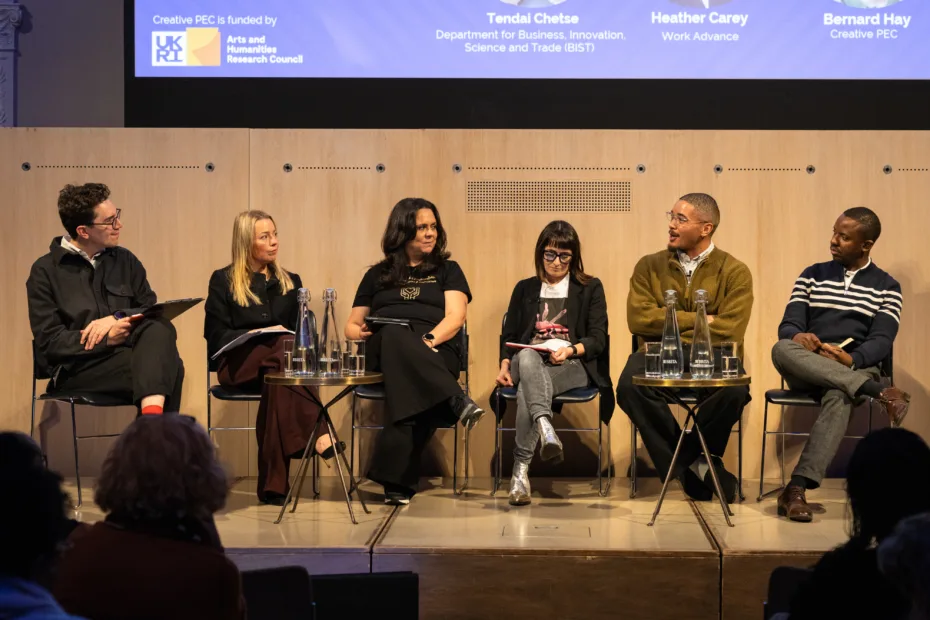
Last week, we launched our latest State of the Nations report, Job quality in the creative industries, 2026, at a sold-out event at RSA House in London, with audiences joining both in person and online.
The launch event, Living the dream? The reality of working in the creative industries, explored the findings of the report and the complex realities of creative work across the UK. Bringing together leading experts from across research, policy and the creative sector, our panel discussed what the findings mean for workers, employers and policymakers, and considered how the sector can support better-quality jobs while sustaining growth and innovation.
We received more questions than we had time to answer during the live discussion. Our expert panel has therefore taken the opportunity to respond to a selection of questions submitted by the online audience, which you can read below.
- Leila d’Aronville, Founder of North East Cultural Freelancers, UK Government Freelance Champion
- Sara Whybrew, Director of Skills and Workforce Development, British Film Institute
- Zak Agnew, Senior Partner Manager, Creative Lives in Progress
- Tendai Chetse, Head of Creative Industries & Sports Economy, Department for Business, Innovation, Science and Trade (BIST)
- Heather Carey, Director, Work Advance
You can rewatch the launch event and panel discussion here:
At a time when high levels of rent push artists and makers away, how do these findings tie in with housing and the cost of living? (Alison)
Sara Whybrew: They don’t, but we recognise that job quality impacts the quality of life outside of work. Cost of living challenges, and potential measures that could be taken to mitigate against these, would benefit from additional research. Improved social security measures for freelancers is something that remains a discussion point as part of the Good Work Review action plan and with the Freelance Champions.
What is the impact of AI on job quality in the creative industries? (Alison)
Heather Carey: This is an interesting question, but not one we’re able to explore through the data (yet). We do, however, explore some of the emerging impacts of AI on the creative industries from a skills perspective, through the Creative Industries Skills Audits we published earlier this year. See Box 5.1 in the Summary report here.
Zak Agnew: I’m not able to give you a direct answer, but I’ve read that ‘UK creative businesses are adopting AI at a higher rate than the wider economy, with 43% reporting AI use compared to 25% across all UK businesses. Across broader UK businesses with 10 or more staff, AI adoption rose from 12% in late 2023 to 35% by June 2026’, see reporting here. It is important to look at this as a reality for the industry as generally the rhetoric towards AI from creatives is negative. I believe it is indicative of the fact that there are not stringent enough resourcing/capacity processes in place across most UK businesses and AI is being leant on heavily to mitigate. From juniors/emerging creatives it is important to note that there is a fear associated with AI (to use in the workplace). Overall, it’s hard to say what its actual impact on job quality is, but it likely adds a new pressure of learning to be used effectively – the potential positives may outweigh the negatives in the long run though. This will depend on how its adoption is perceived (in my opinion). I’d like to add I’m no expert.
How can we reconcile different management styles, i.e. between creative leaders who lack people management skills, and experienced managers who lack understanding of creative work? (Daphne)
Leila D’Aronville: If we had more opportunities in the sector for creatives to progress into leadership without moving into management, I don’t think this would be as much of a problem. Currently, if you are a creative (e.g. theatre director) and want to progress you often have to do that by leading a venue or company. We need creatives AND managers in creative industries. Progression shouldn’t compromise someone’s creative direction in the industry. That is not a practical answer, and I don’t know how we do it in practice.
Heather Carey: We need those who progress into managerial roles to undertake training to upskill in critical areas – the Creative Industries Skills Audits highlight leadership and management as a pressing skills gap for the sector and our work examining management practices (here) suggests managers in the creative industries are far less likely to undertake training than managers across the economy, and management training has actually declined since 2017. At the same time, we need more managers to embed “high-performance workplace practices” that empower their creative workforce. Both the Creative Industries Skills Audits and Management Practices State of the Nations report provide policy recommendations for achieving this in practice.
Are there plans for making creative business skills and competencies, client management skills and collaboration skills available across communities, regions & nations? (Gill)
Heather Carey: Alongside the need for stronger management capability (see my response above), the Creative Industries Skills Audits highlight ‘business critical skills’ as a critical skills gaps and pressing area for upskilling. The recommendations address how these skills might be nurtured at varying points of the skills system and in the workplace – see the summary report here.
Sara Whybrew: The BFI is supporting a range of programmes designed to improve business operational skills in leaders and emerging leaders across different parts of the screen sector. We are happy to share learnings from these programmes as they emerge.
What tangible support can staff from lower socioeconomic backgrounds ask for from leadership in order to thrive in the workplace? (Natasha)
Leila D’Aronville: IMO this is a sector responsibility. This should not be the responsibility of the people who need it, to ask for it. Practically, if opportunities were better financed, organisations thought about flexible roles which sit across different areas of their business and payments to freelance staff were timely with a level of upfront payment. If organisations thought about having access budgets which include travel cost and childcare costs, ensure they’re poverty-proofing the workplace (including things like tea and coffee making facilities, microwave etc – simple things), opportunities to work from home instead of commuting (ensuring at-home costs are also claimable e.g. internet etc). Creating flexible working patterns in part-time roles so that people are able to take up additional work where available. Develop mentoring programmes which extend networks and support people to have a safe space to ask questions and vent frustrations.
But most importantly, ask. Be open and understanding to what comes back to you – really listen and don’t be offended. For some people it will be the cost and precarity of working in the industry, for many it will also be the feeling of not belonging. Think about inclusive culture in all its forms. This Wor Culture Event from 2023, led by Newcastle University and curated by NECF, talks about some of these points.
Heather Carey: I agree with Leila. Creative PEC published a ten-point social mobility plan for the creative industries back in 2021 (here) which was designed to address the systemic barriers and also worked with the Social Mobility Commission to inform their employer toolkit for enhancing workplace practice (here).
What is the data telling us about changing needs in training and skills and what is the best way to bridge this gap between education and workplace, and people in mid-career? (Mark)
Heather Carey: These issues are addressed at length in the Creative Industries Skills Audits here. Both the Summary report and sub-sector audits discuss how employers expect skills needs to change in future, the barriers they face to training and what factors would enable greater investment in skills. The work also highlights a ‘mid-career talent problem’ (both when recruiting talent and looking at skills gaps amongst the existing workforce). The summary report provides detailed recommendations for addressing these issues.
Sara Whybrew: Data is telling us that we need to train people to gain both technical and transversal skills. If we want to improve training in these areas, we need industry and education to work closer together when designing and delivering training – a long-standing issue and ongoing recommendation.
If there is a skill budget surplus in screen, cold a model such as the one used for unspent apprenticeship levy be piloted so any unspent levy is channelled to sub-sectors where skills funding is scarce? (Ian)
Sara Whybrew: There isn’t necessarily a funding surplus in screen, but we know there are healthy levels of skills funding in this part of the creative industries because of the Skills Investment Funds (that are uniquely paid by some screen businesses), the BFI’s National Lottery Skills Funds, separate industry funds being invested by Studios, Broadcasters, and Streamers, as well as Government skills funding including the Growth and Skills Levy. There would be value in screen assessing how funds are currently being used/focused versus identified needs to see if funds are being used to best effect. If they aren’t then we should pivot our focus accordingly. Those who pay the Growth and Skills levy can already transfer 50% of the value of their annual payment (calculated against the previous year) to other organisations to utilise.
Photo: Chiara Luxardo
