
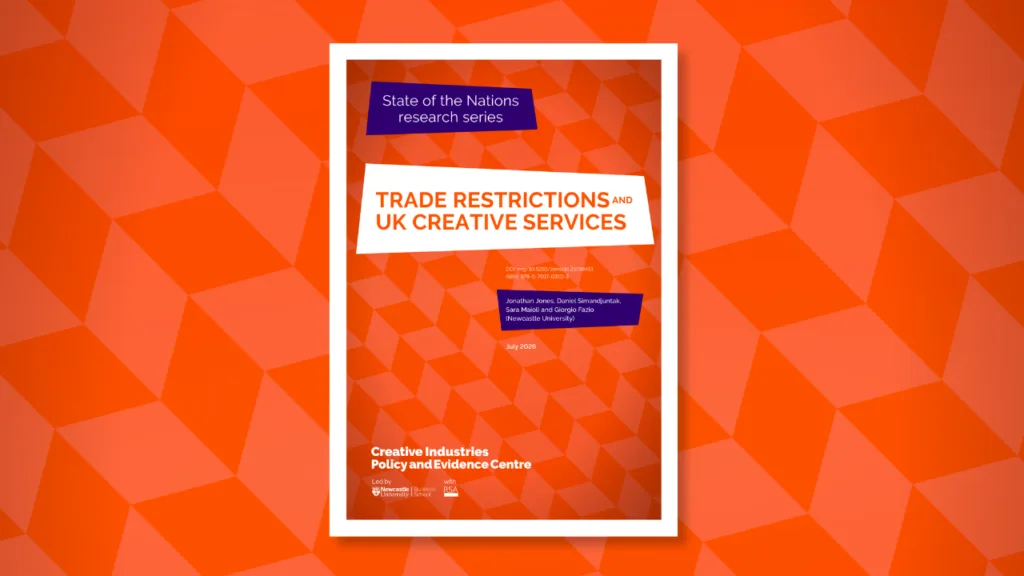
A State of the Nations Research Report
Increasing exports is a central aim of the government’s Industrial Strategy and a priority in the Creative Industries Sector Plan. Our new State of the Nations report, ‘Trade restrictions and UK creative services’, finds there is untapped potential in future growth markets and suggests there is a need to tackle trade restrictions in primary and new markets to realise this.
This report provides a major contribution to the implementation of the government’s Industrial Strategy in detailing for the first time the trade barriers specific to certain creative industries sub-sectors and to different markets. The analysis is the first at scale study to use official creative industries export data from DCMS in conjunction with OECD Services Trade Restrictiveness Index data.
‘Trade restrictions and UK creative services’, published today, is authored by Dr Jonathan Jones, Dr Daniel Simandjuntak, Dr Sara Maioli and Professor Giorgio Fazio of Newcastle University.
Key findings:
- The opportunity for export growth is large: Creative services exports are concentrated in a few primary markets, such as the USA and the EU. In contrast, less than 2% of the UK’s creative services exports were to future growth markets such as Singapore, South Korea and Brazil. (in 2019 –2023).
- Opportunities for growth in creative services exports vary by sub-sector: North America is the main destination for ‘IT, software and computer services’, ‘publishing’ and ‘music, performing and visual arts’ sub-sectors’, the EU for ‘film, TV, video, radio and photography’, ‘advertising and marketing’ and ‘design and designer fashion’, whereas other important destinations for UK creative services exports include the Gulf Cooperation Council countries (in particular, Saudi Arabia) for ‘architecture’ and China for ‘publishing’
- Barriers to creative exporting in services have increased: In several sectors (architecture services, motion pictures, broadcasting, sound recording and computer services) barriers to creative exporting have increased. Despite this, the creative industries have seen their share of UK services exports increase over time, which is a testament to their strength and indicates their potential for further growth if these barriers are addressed.
- Trade restrictions vary across sub-sectors and markets: In both primary and future growth markets, the level of restrictions was highest in architecture services and broadcasting. For the motion pictures, sound recording and computer services sub-sectors, restrictions increased in primary markets, but decreased in future growth markets.
- Trade restrictions on foreign entry is the biggest barrier: This was the biggest restriction for each of the sub-sectors in the future growth markets, and it was dominant in the motion pictures and broadcasting sub-sectors in the primary markets. This includes restrictions such as limitations on foreign equity, quotas on broadcasts and limitations on downloading or streaming. Another notable form of restriction for future growth markets overall was ‘restrictions to movement of people.’
- Restrictions on digital services trade increased: Between 2015 and 2025, restrictions on digital services trade increased and there is variation in how digital restrictions impact individual sectors.
Citation: If the information in this report is used in any subsequent research and/or publications, please cite as follows:
Jones, J. et al. (2026) Trade restrictions and UK creative services. Creative PEC. Available at: https://doi.org/10.5281/zenodo.21298451
Credits
Report design by Mike Green/Green Doe Ltd.
Watch the launch event:
Speakers:
- Francesca Hegyi OBE, Chief Executive of the Edinburgh International Festival and Co-Chair of the Creative Industries Trade and Investment Board (CITIB)
- Aisling Conlon, International Director for UK Advertising, Advertising Association
- Matt Turner MBE, CEO and Founder of Creative Pod and DBT Export Champion
- Professor Giorgio Fazio, Research Director at Creative PEC and Chair of Macroeconomics at Newcastle University Business School
- Dr Daniel Simandjuntak, Research Associate, Creative PEC and Newcastle University Business School
- Dr Jonathan Jones, Senior Lecturer in Economics, Creative PEC and Newcastle University Business School
What are State of the Nations reports?
Creative PEC’s State of the Nations research series analyses the latest data across four thematic areas to inform the development of policies relating to the creative industries. Their scope is the whole of the United Kingdom, and wherever possible data is presented for all the nations and regions. Regular reports on each area will be published biannually over the five years of the Arts and Humanities Research Council (AHRC) funding. The themes and corresponding Research Consortium Partners are:
- R&D, Innovation and Clusters (University of Sussex)
- Internationalisation (Newcastle University)
- Arts, Culture and Heritage (University of Sheffield)
- Education, Skills and Talents (Work Advance)

