
Jenn Blackwood, of Tom Fleming Creative Consultancy (TFCC), introduces the Civic Creativity Network and Index, a Creative PEC-commissioned pilot testing how five UK places are using culture as a tool of governance.
This project was funded by one of Creative PEC’s Small Research Network Grants. These awards bring together Creative PEC Research Fellows with the aim of promoting research and policy understanding in key areas and supporting initiatives that deliver tangible benefits within academic, policy and practitioner communities. Find out more about the projects here.
Local authorities and combined authorities across the UK are being asked to do more with less: deliver inclusive growth, improve wellbeing, respond to the climate crisis, strengthen democratic participation, and rebuild trust in public institutions, all against a backdrop of tightening budgets and short-term funding cycles. In that environment, culture is too often at risk of being sidelined as a valuable but non-statutory activity that sits at the margins of core policy and investment.
A growing body of evidence suggests that such framing understates what culture actually does for a place. At its best, culture can shape identity, build social cohesion, support wellbeing, and create the conditions for more inclusive local economies. It is, essentially, civic infrastructure.
Between September 2025 and May 2026, we set out to test the idea of ‘Civic Creativity’: the intentional use of cultural and creative practice within local governance and place-based partnerships to enhance social, economic, and environmental outcomes, strengthen community engagement, and contribute to sustainable local development. We worked with five UK municipalities to explore how this works in practice.
Where the idea comes from
Civic creativity builds on work undertaken by TFCC for the Calouste Gulbenkian Foundation to reframe how cultural organisations engage with their local context, shifting from nationally driven funding priorities toward place-based, community impact. It also draws on knowledge exchanges with Eurocities, which found that cities increasingly recognise culture’s strategic value, but often struggle to translate that recognition into coordinated leadership, investment and delivery.
We also looked at what was already out there to measure culture’s contribution to place. Frameworks like the Culture and Heritage Capital Framework, the new National Culture Framework and Creative UK’s Culture as Growth Infrastructure make a strong economic case for cultural investment. The UN Sustainable Development Goals and Kate Raworth’s Doughnut Economics model make an equally strong case for wellbeing and meeting the needs of all people within the means of our planet. What none of them do is capture the relational, participatory, and highly place-specific way that culture is actually being used inside local government and as a way of working with communities. The Civic Creativity Network and Index pilot addresses this gap.
Testing the idea: five places, five approaches
We designed the Civic Creativity pilot with five place-based partnerships which were selected based on geographic diversity, governance and cultural ecosystem. We designed and tested a prototype index with them and against a cultural initiative of their choosing:
- Dumfries and Galloway Council – a rural Cultural Partnership, taking a steady, trust-building approach to connect culture with economic development across a dispersed rural region.
- Belfast City Council – the Bank of Ideas, a participatory grant programme where communities themselves vote on how cultural funding is spent.
- West Midlands Combined Authority – a £4.1 million Commonwealth Games cultural pillar, delivered across seven authorities through secondments and cross-sector partnership.
- Swansea Council – Creative Swansea, a network connecting and amplifying the city’s creative and cultural sector.
- West of England Combined Authority (WECA) – Citizens for Culture, the UK’s first Citizens’ Assembly on culture, producing 13 recommendations that now shape a regional Cultural Plan.
Through interviews, workshops, roundtables and a shared digital space for exchange, we worked with each place to co-create and then test a prototype ‘Civic Creativity Index’ built around five dimensions: leadership and governance; policy and systems embedding; partnerships and communities; resources and sustainability; and learning and change.
What we learned
There were clear and consistent opportunities and challenges across all five places despite their differences.
Firstly, civic creativity works best when senior arts and cultural leaders treat culture as integral to wider goals, such as health or social cohesion, and it is embedded in organisational strategies. When initiatives are framed as a cross-cutting method for tackling recognised problems, such as loneliness or social cohesion, buy-in from the wider organisation and partners is more likely.
Secondly, embedding tends to happen “by stealth”. Several participants told us civic creativity had gradually earned its place in wider policy through sustained progress and demonstrable success. Where buy-in existed, participatory methods first developed inside cultural teams, like WECA’s Citizens’ Assembly model with their partners, or Belfast’s Bank of Ideas, started migrating as examples of best practice into planning and regeneration in other parts of the organisation too.
Thirdly, there was strong evidence of municipalities deliberately reaching beyond the ‘usual suspects’ in their participatory design and practice. Belfast’s Bank of Ideas engaged and newly networked 34 community centres directly in participatory budgeting, and the West Midlands built hyper-local, constituency-specific engagement strategies. WECA’s Citizens for Culture model ensured 51 citizens from diverse backgrounds were selected to form the assembly, from 15,000 invitations sent out across Bristol.
Fourthly, funding is fragile everywhere. Every place we worked with was juggling short-term grants, annual allocations and one-off funding pots to create long-term sustainable provision and progress, and every place struggled with the same problem: proving measurable value in order to secure the next round of investment. This points to more robust and easy-to-adopt monitoring and evaluation frameworks as central to what comes next.
Finally, every participant told us that their innovative participatory, collaborative ways of working now represented the future direction of their practice, and had shifted their wider organisation’s strategy and policy towards supporting cultural participation.
Why this matters now
The clearest policy implication of this pilot is that the monitoring and evaluation tools that culture currently uses are not fit for purpose. They were not designed to capture the wider impacts of cultural practice and investment, and that gap has consequences for how culture is funded, governed and valued.
Existing frameworks capture part of the picture, including various spillovers, but they often equate such value with monetary outcomes. But they fall short of capturing what we saw across all five places: culture being used as a vector of place-based development to build trust, resolve tension, reach people beyond the ‘usual suspects’ and change how public institutions work with communities. These are often the most significant outcomes of cultural investment, and they are largely invisible in the evidence that senior cultural leader decision-makers rely on.
That invisibility matters because what we measure shapes what gets funded. Each municipality strives to demonstrate its value in order to secure the next round of investment: they want to reflect the full impact of their work. This is not fully captured, so the civic value of culture goes unrecorded, therefore it goes unfunded and remains marginal. Breaking that cycle has implications for several parts of the system.
For national government and funders: develop a shared civic measure. The Civic Creativity Index is a light-touch, shared set of civic indicators that sits alongside existing economic and wellbeing measures. These could cover who participates and who doesn’t, whether trust in local institutions changes, and whether participatory methods spread into other public services. National funders and government departments are best placed to convene this, so that local authorities are not each reinventing evaluation with limited capacity.
For funders: match evaluation timescales to the outcomes being sought. Civic outcomes such as trust and cohesion build slowly, as Dumfries and Galloway’s patient approach across a dispersed rural region shows. Annual allocations and one-off pots ask places to demonstrate long-term change on short-term timelines. Multi-year, flexible funding, paired with evaluation that tracks change over that longer period, would give a truer picture of what investment achieves.
For local and combined authorities: make civic cultural impact visible in core strategy. In the pilot, civic creativity often became embedded “by stealth”, earning its place through visible success and committed individuals. Better evidence would allow that case to be made openly. Naming culture’s contribution in health, cohesion, regeneration and local growth strategies, and reporting against it, would make that progress less dependent on particular culture leaders and more resilient when budgets tighten.
For fairness between places: measure practice and scale. Places with strong institutions, established cultural clusters or major one-off investment, such as a Commonwealth Games or a City of Culture bid, are best placed to generate the kind of evidence current tools reward. Measures that capture the quality of civic practice as well as its scale, would help smaller, rural and less-resourced places make their case, and enable funders to target support fairly.
Devolution: a mechanism for civic creativity?
Recent reforms of the The English Devolution and Community Empowerment Act 2026 establish Strategic Authorities as a new tier of English local government and, after sector campaigning, name culture as one of their areas of competence. Two of our pilot places, the West Midlands and West of England combined authorities, already show what regional civic creativity can look like. The Act’s new duty on councils to provide effective neighbourhood governance also creates openings for tested participatory methods like Belfast’s Bank of Ideas.
The Local Government Association has called for sector-co-produced guidance to define what culture covers. This is a chance to make culture’s civic role explicit. Without it, culture risks being counted only through growth metrics in Strategic Authorities Local Growth Plans, leaving its contribution to trust and participation invisible once again.
Local government reorganisation (LGR), replacing district councils with unitary authorities in several counties, may also disrupt the relationships civic creativity depends on, and these reforms apply to England only. With pilot places across all four nations, lessons will transcend across the UK and beyond.
Measuring what matters
We are clear that solving this is complex. Our participants found that scoring against the draft index felt subjective, shaped as much by a place’s scale, geography and existing infrastructure as by the strength of its civic creativity practice. That challenge is exactly why this work needs to continue. Capturing civic impact fairly and robustly is difficult, but the alternative is to keep measuring culture in ways that miss much of what it does.
What’s next
At TFCC, we now want to scale this pilot, expanding the network to a larger and more diverse sample of UK places, and refining the index, scoring and evaluation so it can compare fairly across very different scales, timelines and geographies. We’re also in early conversations with European and international municipal networks, including Eurocities and Culture Next, about where this framework travels beyond the UK.
If your local authority, combined authority, or place-based partnership wants to be part of the next cohort, or just wants to talk about what civic creativity looks like where you are, get in touch at info@tfconsultancy.co.uk.
With thanks to Dumfries and Galloway Council, Belfast City Council, West Midlands Combined Authority, West of England Combined Authority, Swansea Council, South of Scotland Enterprise, Citizens for Culture and University of A Typical.
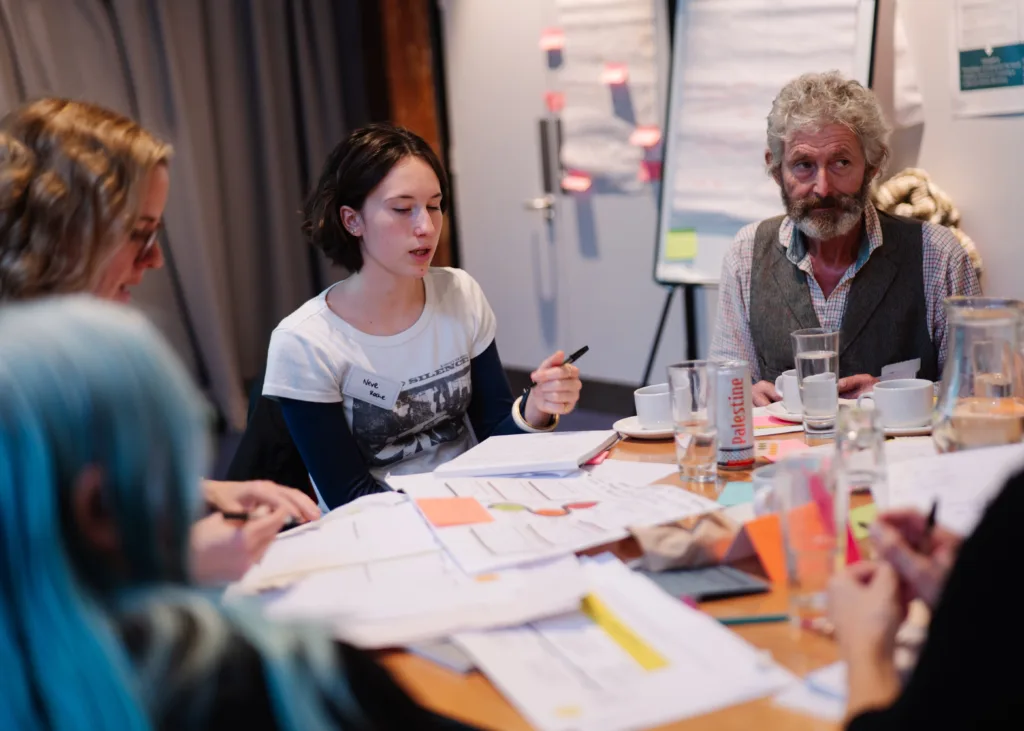
Photo credit: Ciara Hillyer for Citizens for Culture, WECA
Illustration by Alexander Naughton
