
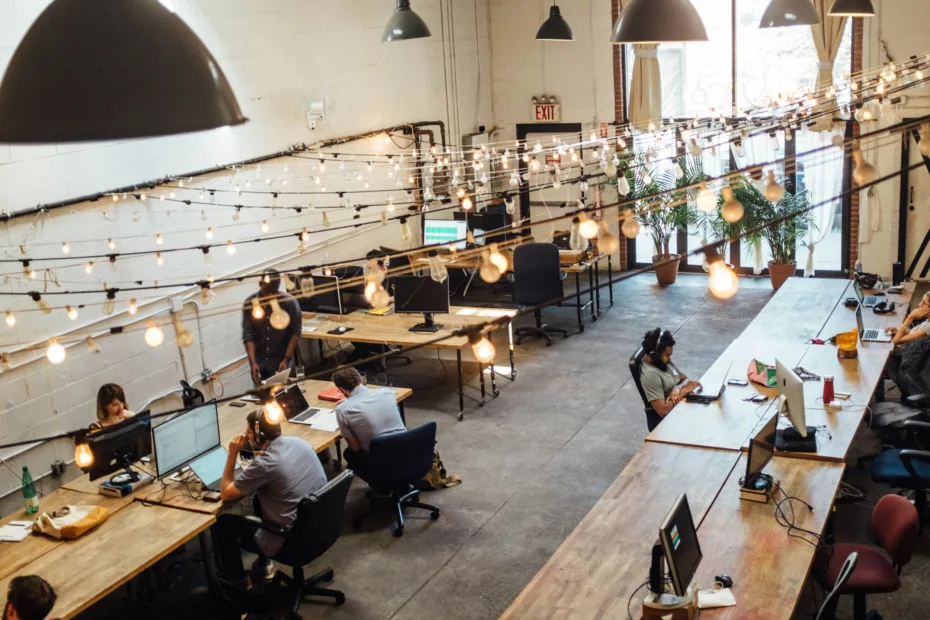
This guest blog is by Dr Zihan Wang, SPRU, University of Sussex Business School.
Coworking spaces have become an increasingly important component of the creative economy. With a strong tendency to co-locate alongside creative industry firms, these spaces bring together freelancers, remote workers and ‘digital nomads’, supporting the growing number of independent workers within the sector.
Traditionally associated with flexibility, entrepreneurship and community, coworking spaces are now increasingly recognised for a different role. Emerging research suggests that they may provide informal co-learning and co-educational environments, facilitating everyday ad hoc learning processes among co-workers and contributing to the development of new skills from the bottom up. This is particularly salient for the creative industries, where the workforce is structured markedly differently from many other sectors, and where these differences shape how skills are developed, accessed and sustained over time.
A dilemma for an independent workforce with evolving skill demands
A defining feature of the creative industries is the high prevalence of freelance and project-based work. Many creative workers operate as independent workers (including freelancers and self-employed workers), working outside traditional organisational structures and moving between clients, contracts and collaborations.
This has important implications for skill development. Independent creative workers typically lack access to structured on-the-job training systems or internal career progression pathways, which remain key channels for upskilling among corporate employees.
At the same time, creative workers are often early adopters of new technologies. The rapid pace of technological change creates a continuous need to update skillsets. Recent work by Creative PEC highlights how Generative AI is further reshaping skill demands, with creativity and AI skills increasingly required in tandem to embed new Generative AI tools within creative workflows.
This creates a clear dilemma: high demand for continuous skill development, but limited access to workplace-based upskilling opportunities.
New evidence: coworking spaces as informal skill ecosystems
New research has been published in the academic journal Regional Studies. Drawing on a survey of managers and co-workers from 161 coworking spaces across 74 UK regions, and using a web-scraped database of UK coworking spaces to construct the survey sampling frame, the research suggests that coworking spaces can help to bridge this skills gap by providing environments where skills are developed through everyday practices. Two key mechanisms are particularly important:
- Informal social interactions within coworking spaces (including spontaneous networking and community events) are positively associated with the development of social-cognitive skills such as collaboration, client communication, idea pitching, and creative problem-solving.
- Utilisation of shared resources (including physical infrastructure and targeted training opportunities) is positively associated with the development of technical-digital skills, such as the use of design software, digital content production tools, and coding for creative applications.
Importantly, these mechanisms operate differently across regional contexts. In left-behind regions (characterised by a consistently below-average gross domestic product (GDP) per capita, low or negative employment growth, and stagnant or declining population levels), members of coworking spaces benefit particularly from structured resources to develop technical-digital skills; Whereas in non-left-behind regions, social-cognitive skill development tends to emerge more organically, through bottom-up interactions within coworking spaces. This pattern is supported by the empirical analysis, which shows that the association between resource utilisation and technical–digital skill development is significantly stronger in left-behind regions, while the association between social interactions and social–cognitive skills is more pronounced in non-left-behind regions.
Looking at co-worker characteristics, further patterns emerge. Evidence shows that, compared to employees, independent workers experience greater development in technical–digital and social–cognitive skills within coworking spaces.
These effects are especially pronounced for workers in creative occupations such as designers, digital content creators, filmmakers and game developers, particularly in relation to technical-digital skills. This likely reflects the pace of technological change in creative work, including the growing importance of digital tools and AI-enabled production. By providing access to emerging technologies, training opportunities and hands-on experimentation, coworking spaces enable creative workers to integrate new tools, including advanced generative AI, into their workflows, supporting continuous learning, adaptation and skill upgrading.
What this means for policy
These findings suggest that coworking spaces should be understood not only as a new form of workspace, but potentially as part of the informal skill infrastructure supporting the creative workforce. Importantly, their role varies across regional contexts, pointing to the need for place-based policy approaches. Three implications follow.
- Recognising coworking spaces as informal skill ecosystems
For many independent creative workers, coworking spaces offer an accessible setting for continuous skill development beyond formal education, without requiring significant time or financial commitments.
This is particularly important in left-behind regions, where access to cutting-edge hardware, digital tools and structured training opportunities may be more limited in general. In these contexts, engagement with coworking spaces may play a key role in supporting the development of technical-digital skills, which are increasingly critical amid rapid technological change and the growing adoption of generative AI.
- Supporting access for creative workers
Access remains uneven. Membership costs can act as a barrier, particularly for early-career or lower-income creatives in left-behind regions. Targeted interventions such as subsidised memberships, vouchers, or support schemes linked to local skills programmes, could help broaden participation.
- Embedding coworking spaces within place-based creative ecosystem strategies
Policy should make greater use of the co-location between coworking spaces and creative industry firms. Integrating these spaces into wider place-based strategies including initiatives around creative clusters and emerging microclusters, would help strengthen informal networks, support knowledge exchange, and expand opportunities for continuous skill development across the creative industries.
Photo by Shridhar Gupta on Unsplash
