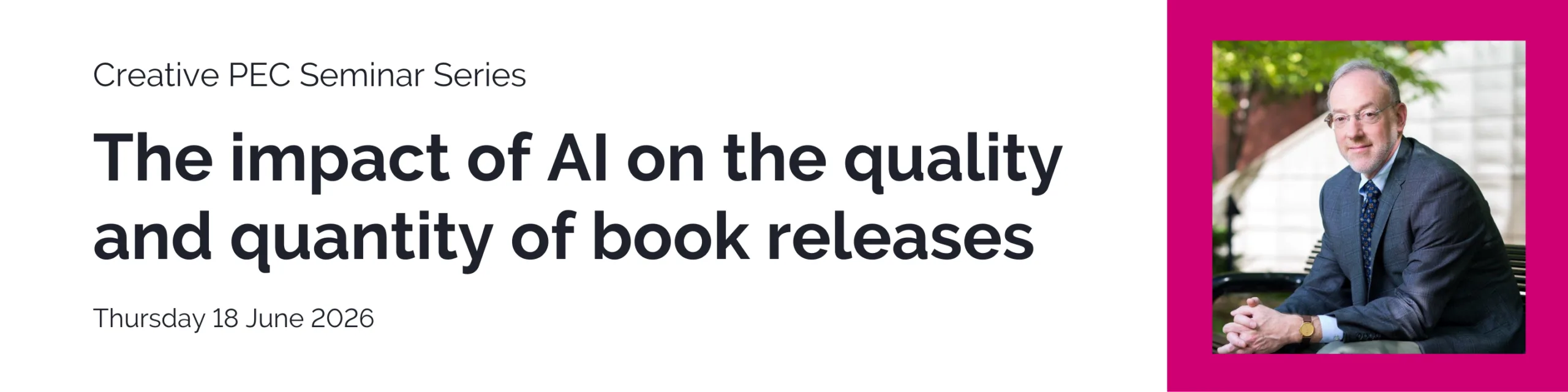
With the diffusion of Large Language Models (LLMs) between 2022 and 2025, new book releases have tripled, raising a question of AI’s impact on book quality. This seminar presents new research conducted by Imke Reimers and Joel Waldfogel on how the diffusion of LLMs has reshaped the publishing sector and the impact of AI on both the volume and perceived quality of books entering the market.
- 3pm, Thursday 18 June 2026, online
The research develops a ratings-based measure to compare quality across different book release vintages. The analysis finds that the wave of titles released during the AI influx period has lower average quality overall. However, the results also show that quality has improved among the top 1,000 monthly releases within each category, although not the top 100, and that these gains are strongest in categories experiencing the fastest growth in new titles. The study further finds that authors entering the market since the rise of LLMs tend to produce predominantly lower-quality work, while the output quality of pre-LLM authors has increased.
During the session, Joel Waldfogel will discuss the study’s data, methodology and findings. There will be time for Q&A following the presentation.
This 1-hour talk is part of Creative PEC‘s Seminar Series.
Speakers

Joel Waldfogel
Frederick R. Kappel Chair in Applied Economics
University of Minnesota’s Carlson School of Management
Joel Waldfogel is the Frederick R. Kappel Chair in Applied Economics at the University of Minnesota’s Carlson School of Management and a research associate of the National Bureau of Economic Research. Between 2017 and 2023, he was the Associate Dean for MBA and MS Programs at the Carlson School. Before coming to Carlson, Waldfogel was at the University of Pennsylvania’s Wharton School (1997-2010), where he was the Ehrenkranz Family Professor of Business and Public Policy and had served as department chair and associate vice dean. Between 1990 and 1997, he was an assistant and later an associate professor of economics at Yale University. During 2021-2022 he was the Kaminstein Scholar at the US Copyright Office.
Waldfogel’s main broad research interests are industrial organization and law and economics. He has conducted empirical studies of price advertising, media markets, the operation of differentiated product markets, and issues related to digital products, including piracy, pricing, revenue sharing, and the effects of digitization on the supply of new products.
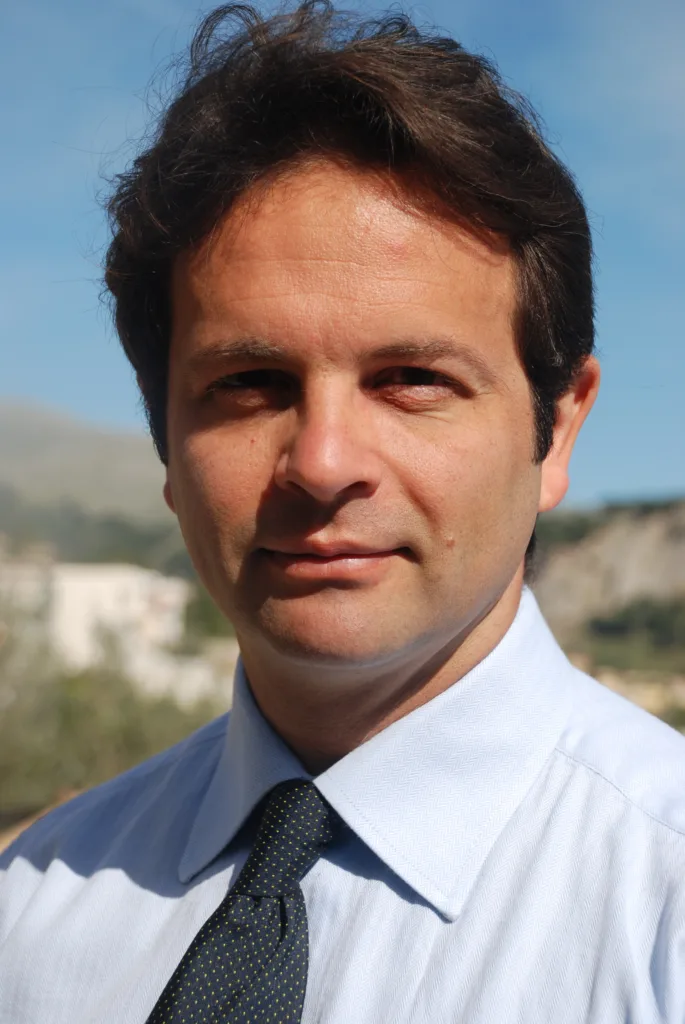
Giorgio Fazio (chair)
Professor of Macroeconomics
Newcastle University
Giorgio Fazio is an applied economist with expertise in macroeconomics, trade and investment. He has published several articles in international peer-reviewed journals and chapters in edited books on issues such as exchange rates determination, crises and contagion, growth, and convergence at the national and regional levels, productivity, innovation, trade and FDI, civic and cultural capital, creative industries economics.
He has been a Creative PEC researcher since 2018, leading the work on international trade, investment and migration and contributing to economic research in the creative industries in PEC Discussion papers, blogs and peer reviewed journal articles.
Giorgio is Chair of Macroeconomics at Newcastle University Business School and since 2023 is the Research Director of the Creative Industries Policy Evidence Centre.
