Issue date: Thursday 23 April 2026 11am UK time
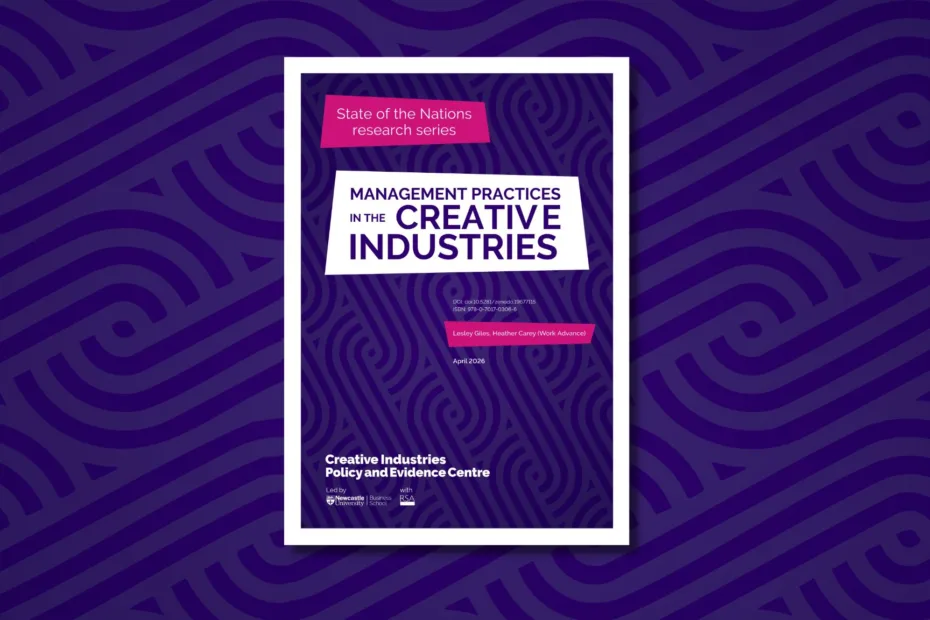
New research, published today, finds there is significant room for improvement in management practices in the creative industries. Based on analysis of data from three Government endorsed national business surveys, the study from the Creative Industries Policy and Evidence Centre (Creative PEC) shows that greater investment in management training is essential to bolster the creative industries; a priority area for growth in the Government’s Industrial Strategy.
One of the factors most consistently believed by economists to explain the UK’s low productivity is the shortcoming in management capabilities. The good news for the creative industries, revealed by today’s report, is that overall management practices are stronger in creative sectors than in the wider economy. However, the researchers have found several areas with significant room for improvement, where investing in management capacity could have positive far-reaching consequences for individual firms and UK productivity overall.
Co-author of the report Heather Carey, Co-Director, Work Advance says:
“Across the economy, there is compelling evidence that management practices are a critical driver of productivity and firm performance, and a key contributor to the UK’s productivity puzzle. This report shows that, in many respects, creative industries firms are ahead of the curve – with strong performance on innovation, technology adoption and overall management capability.
But it also highlights clear areas for action: strengthening more formal management approaches, tackling persistent underinvestment in management development, and accelerating the diffusion of best practice from leading firms. Enhancing management capability must be central to delivering the ambitions set out in the Creative Industries Sector Plan.”
Key findings:
- Overall management practices in the creative industries exceed those of the wider economy. In 2023, the average management score for creative firms with 10+ employees was 0.60 compared to 0.55 across all industries.*
- There is considerable variation in the take-up of different management practices, with the research suggesting scope to strengthen formal management practices, such as the use of KPIs, mechanisms for employee consultation and adoption of accredited management standards.
- There has been sustained underinvestment for nearly a decade and managers in the creative industries are amongst the least likely staff to receive training compared to other occupations.
- Training for managers in the creative industries firms is significantly lower than the wider UK economy average (33% vs 44%).
- SMEs in the creative industries with stronger management practices perform better across the board of business indicators.
- Creative firms with the weakest management scores are the least likely to be taking action to improve the running of their business. Few seek external expert advice in driving improvements, either from training consultants or by engaging with government-funded training programmes.
Bernard Hay, Director of Policy, Creative PEC says:
“This new report adds further weight to the idea that creative firms with better management practices are also more likely to report better business outcomes, be they improved turnover, employment growth or innovation activity. It also highlights that whilst the sector tends to demonstrate high levels of management capability, investment in management training and skills remains low and has declined even further since 2017.
As policymakers across the UK seek to unlock the growth potential of the creative industries, increasing the availability, development and take-up of relevant management training and up-skilling in the sector should be prioritised.”
‘Management practices in the creative industries’ is the latest report in the Creative PEC’s ‘State of the Nations’ series which provides regular, independent and authoritative evidence to support good policy making. Creative PEC research was referenced 26 times in the Government’s ten-year Sector Plan for the Creative Industries, with Creative PEC Director Professor Hasan Bakhshi a member of the Government’s Creative Industries taskforce.
The research team and spokespeople for the Creative PEC are available for comment and interview.
Press contacts
Alice Kent alice.kent@pec.ac.uk (Monday-Wednesday) and Simon Jones (Thursday – Friday) simon.jones@pec.ac.uk
Notes
* Data from the ONS Management Expectations Survey (MES) 2023. Scores derived from 18 structured management practices across four dimensions: continuous improvement; employment practices; and the use of KPIs and targets. Management practices are scored between zero and one, depending on the extent to which the practice is embedded in the firm. An average is then generated to create an overall score for management practices. Higher scores imply that a firm has adopted a stronger set of structured management practices.
Notes to editors
1. State of the Nations reports
The report is part of the Creative PEC’s State of the Nations research series, which uses the latest data to inform policymakers on how best to support the creative sector across four thematic areas. Regular reports on each area will be published annually over the five years of the Arts and Humanities Research Council (AHRC) funding period.
2. About the Creative Industries Policy and Evidence Centre (Creative PEC)
Creative PEC works to support growth of the UK’s Creative Industries through the production of independent and authoritative evidence and policy advice. Led by Newcastle University with the Royal Society of Arts and funded by the UKRI Arts and Humanities Research Council, the Centre comprises a core consortium of; Newcastle University, Work Advance, Sussex University and the University of Sheffield. The PEC works with a diverse range of industry partners.
For more details visit www.pec.ac.uk, follow us on LinkedIn and Bluesky, or sign up to our newsletter.
3. About The UKRI Arts and Humanities Research Council
The UKRI Arts and Humanities Research Council (AHRC), part of UK Research and Innovation, funds internationally outstanding independent researchers across the whole range of the arts and humanities: history, archaeology, digital content, philosophy, languages and literature, design, heritage, area studies, the creative and performing arts, and much more. The quality and range of research supported by AHRC works for the good of UK society and culture and contributes both to UK economic success and to the culture and welfare of societies across the globe.
4. ‘Management practices in the creative industries’ by Lesley Giles and Heather Carey (Work Advance) was designed by Mike Green at Green Doe Graphic Design
