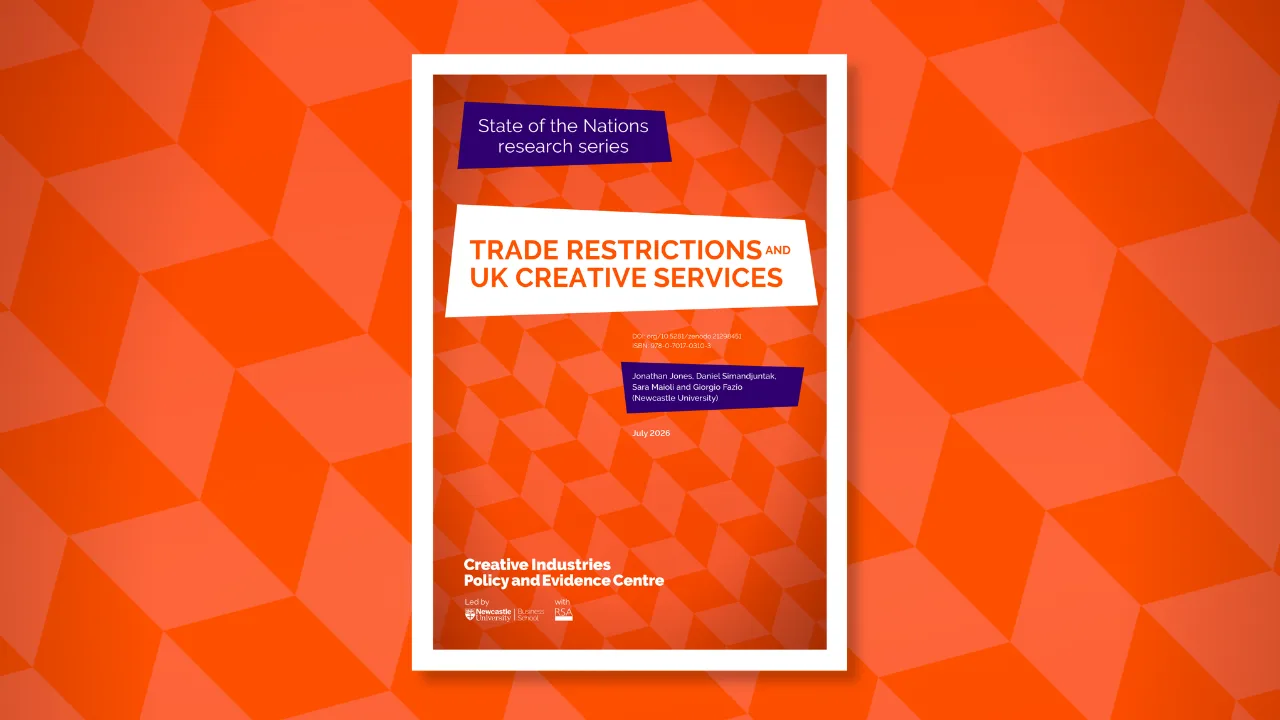
New Creative PEC research shows the huge potential for creative services exports growth. Increasing exports is a central aim of the government’s Industrial Strategy and a priority in the Creative Industries Sector Plan. The new report Trade Restrictions and UK Creative Services finds there is untapped potential in future growth markets and suggests there is a need to tackle trade restrictions in primary and new markets to realise this.
This report provides a major contribution to the implementation of the government’s Industrial Strategy in detailing for the first time the trade barriers specific to certain creative industries sub-sectors and to different markets. The analysis is the first at scale study to use official creative industries export data from DCMS in conjunction with OECD Services Trade Restrictiveness Index data.
Francesca Hegyi OBE, Co-Chair of Creative Trade Forum (CTF) and Chief Executive of the Edinburgh International Festival says:
“This report gives a clear picture of a long-standing challenge – the biggest obstacle to growing creative exports isn’t demand, it’s the practical mechanics of trade. Restrictions on foreign entry and the movement of people remain among the most significant barriers our exporters face abroad, and UK creative exports have nearly doubled while staying largely within the same familiar markets. As the Creative Trade Forum launches next month, there’s huge, untapped potential for our Creative Industries if we tackle these barriers head-on with the new Government.”
Report co-author Dr Jonathan Jones, Newcastle University Business School says:
“There is huge potential for the UK’s creative industries services exporters to deepen their presence in future growth markets, where trade levels remain low. The Creative Industries Sector Plan aims to boost exports in both established and emerging markets, but realising these ambitions requires overcoming significant challenges from global trade uncertainty, geopolitical tensions and, as our report shows, persisting services trade barriers. An overarching implication is that there is an overall need to strengthen trade diplomacy and trade support for creative industries exporters.”
Key findings include:
- The opportunity for export growth is large: Creative services exports are concentrated in a few primary markets, such as the USA and the EU. In contrast, less than 2% of the UK’s creative services exports were to future growth markets such as Singapore, South Korea and Brazil. (in 2019 –2023).
- Opportunities for growth in creative services exports vary by sub-sector: North America is the main destination for ‘IT, software and computer services’, ‘publishing’ and ‘music, performing and visual arts’ sub-sectors’, the EU for ‘film, TV, video, radio and photography’, ‘advertising and marketing’ and ‘design and designer fashion’, whereas other important destinations for UK creative services exports include the Gulf Cooperation Council countries (in particular, Saudi Arabia) for ‘architecture’ and China for ‘publishing’
- Barriers to creative exporting in services have increased: In several sectors (architecture services, motion pictures, broadcasting, sound recording and computer services) barriers to creative exporting have increased. Despite this, the creative industries have seen their share of UK services exports increase over time, which is a testament to their strength and indicates their potential for further growth if these barriers are addressed.
- Trade restrictions vary across sub-sectors and markets: In both primary and future growth markets, the level of restrictions was highest in architecture services and broadcasting. For the motion pictures, sound recording and computer services sub-sectors, restrictions increased in primary markets, but decreased in future growth markets.
- Trade restrictions on foreign entry is the biggest barrier: This was the biggest restriction for each of the sub-sectors in the future growth markets, and it was dominant in the motion pictures and broadcasting sub-sectors in the primary markets. This includes restrictions such as limitations on foreign equity, quotas on broadcasts and limitations on downloading or streaming. Another notable form of restriction for future growth markets overall was ‘restrictions to movement of people.’
- Restrictions on digital services trade increased: Between 2015 and 2025, restrictions on digital services trade increased and there is variation in how digital restrictions impact individual sectors.
Bernard Hay, Policy Director, Creative PEC says:
“This research demonstrates the significant value the UK creative industries offer to international markets and outlines to policymakers their distinctive needs when it comes to trade support and the removal of barriers within sub-sectors and between different markets. As a major UK export, the creative industries should remain a priority for trade diplomacy with new and established markets. Domestically, the refresh of the Creative Industries Trade and Investment Board provides a good moment to promote the visibility of UK creative industries.”
The report ‘Trade restrictions and UK creative services’ is by Jonathan Jones, Daniel Simandjuntak, Sara Maioli and Giorgio Fazio, Newcastle University. It was launched on 22 July where a panel of industry experts discussed the findings – Francesca Hegyi OBE, Chief Executive of the Edinburgh International Festival and Co-Chair of the Creative Industries Trade and Investment Board (CITIB), Aisling Conlon, International Director for UK Advertising, Advertising Association and Matt Turner MBE, CEO and Founder of Creative Pod and DBT Export Champion.
/ENDS
Download the report: Trade Restrictions and UK Creative Services by Jonathan Jones, Daniel Simandjuntak, Sara Maioli and Giorgio Fazio, Newcastle University https://pec.ac.uk/state_of_the_nation/trade-restrictions-uk-creative-services/ (live from 10 am on Wednesday 22 July 2026)
The research team and spokespeople for the Creative PEC are available for comment and interview.
Press contacts
Alice Kent alice.kent@pec.ac.uk (Monday-Thursday) and Simon Jones (Friday) simon.jones@pec.ac.uk
Notes to editors
1. State of the Nations reports
The report is part of the Creative PEC’s State of the Nations research series, which uses the latest data to inform policymakers on how best to support the creative sector across four thematic areas. Regular reports on each area will be published annually over the five years of the Arts and Humanities Research Council (AHRC) funding period.
2. About the Creative Industries Policy and Evidence Centre (Creative PEC)
Creative PEC works to support growth of the UK’s Creative Industries through the production of independent and authoritative evidence and policy advice. Led by Newcastle University with the Royal Society of Arts and funded by the UKRI Arts and Humanities Research Council, the Centre comprises a core consortium of; Newcastle University, Work Advance, Sussex University and the University of Sheffield. The PEC works with a diverse range of industry partners.
For more details visit www.pec.ac.uk, follow us on LinkedIn and Bluesky, or sign up to our newsletter.
3. About The UKRI Arts and Humanities Research Council
The UKRI Arts and Humanities Research Council (AHRC), part of UK Research and Innovation, funds internationally outstanding independent researchers across the whole range of the arts and humanities: history, archaeology, digital content, philosophy, languages and literature, design, heritage, area studies, the creative and performing arts, and much more. The quality and range of research supported by AHRC works for the good of UK society and culture and contributes both to UK economic success and to the culture and welfare of societies across the globe.
4. ‘Trade Restrictions and UK Creative Services’ was designed by Mike Green at Green Doe Graphic Design
