
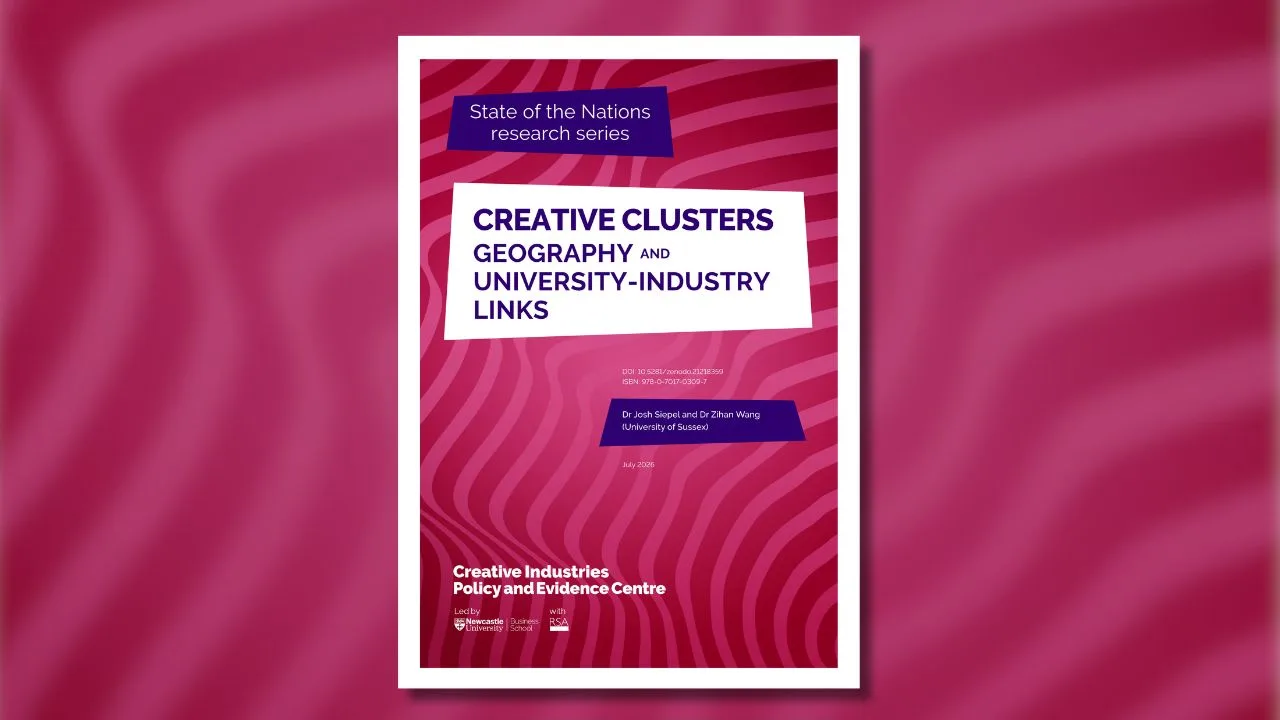
New research published today by the Creative Industries Policy and Evidence Centre (Creative PEC) reveals the vital role universities play in supporting place-based growth and innovation. The report ‘Creative Clusters, Geography and University-Industry Links‘ also shows that between 2011 – 2024 the relative importance of the creative industries to regional economies increased for every region and nation of the UK. As place-based ‘good growth’ moves up the political agenda, the findings also demonstrate how universities can adapt to local and regional creative economy strengths and maximise industry-education partnerships to support place-specific initiatives.
Bernard Hay, Creative PEC, Director of Policy says:
“These findings reinforce Creative PEC’s research to date: unlocking the UK’s creative industries growth potential requires policies that are able to be responsive to the distinctive needs of places, while building on local strengths. It also reminds us of the important role universities play in local creative ecosystems. Alongside being a vital part of the talent pipeline, they deploy a breadth of mechanisms to support innovation in creative firms. As regional growth moves up the political agenda, strengthening the capacity of universities and local creative businesses to collaborate should remain a priority.”
The report is by Dr Josh Siepel and Dr Zihan Wang, University of Sussex Business School.
Key findings:
Regional creative industries employment growth
- Over the 2011-2024 period, the share of regional employment in the creative industries has increased for all of the UK’s nations and regions. For example, from 2.8% to 4.1% in the North of England, 4.4% – 6.6% in the East of England and 4.5% – 6.0% in the South West.
- There is some evidence that the gap in creative industries employment between London and the South East and the rest of the UK may have narrowed slightly in the 2022-24 period, although this may be explained by the rise of hybrid working.
- The scale of creative jobs increases is substantial relative to the size of local creative industries in several parts of the country. For instance, Between 2022 – 24 there was an increase of 17,000 jobs in the East of England, 13,000 in the North West, 7,000 in Scotland, 5,000 in Northern Ireland and 3,000 in the North East and Wales.
- Twelve of the DCMS clusters saw creative industries employment growth higher than 10% from 2022 to 2024; of these, six were in the South West and three were in the East of England.
- New evidence on where creative industries are growing and how places specialise is included with the report detailing the 15 cities and towns which have seen the highest net creation of creative industry jobs between 2022 – 24.
The role of universities in driving innovation
- Universities have a vital role in catalysing, growing and sustaining creative clusters. Beyond the contribution of graduates, other forms of university – industry interactions, such as spinouts, research collaborations and Knowledge Transfer Partnerships, can help to support businesses and local growth.
- University spinouts within the creative industries often stay within the area of the university in which they were originally founded.
- In many creative cluster areas creative businesses account for an outsized share of UKRI-funded research partnerships, with rates particularly high in places like Brighton.
- The prevalence of high levels of university – industry interactions in London, Cambridge and Oxford points to the benefits that can come from the development of strong university level technology transfer mechanisms, which can incentivise commercialisation and provide expertise to allow university-derived knowledge to be scaled up.
- The rates at which universities collaborate with local creative industry businesses vary significantly across a range of potential interventions. This points to the wide range of approaches universities use to successfully engage with and support creative industries.
- Universities play a practical role in enabling creative innovation ecosystems.The report finds however that these relationships remain uneven across the UK, particularly in rural and coastal areas, highlighting opportunities to strengthen local innovation ecosystems through deeper university-business partnerships.
Report co-author Dr Josh Siepel, University of Sussex Business School says:
“Creative growth is becoming more geographically distributed. While London and the South East remain the regions with the largest creative economies in the UK, there is encouraging employment growth across major creative clusters in cities and other regions int he UK. These findings offer timely insights into how creative clusters, universities and local innovation ecosystems can support sustainable regional growth. Creative growth is increasingly evident across cities beyond London, providing timely evidence for Mayoral Strategic Authorities and other local leaders as new devolved powers are implemented.”
/ENDS
Download the report: ‘Creative Clusters, Geography and University-Industry Links’, published today, is by Dr Josh Siepel and Dr Zihan Wang, University of Sussex, https://pec.ac.uk/rd-innovation-and-clusters/ (live from 00.01 on Thursday 9 July 2026)
The research team and spokespeople for the Creative PEC are available for comment and interview.
Press contacts
Alice Kent alice.kent@pec.ac.uk (Monday-Thursday) and Simon Jones (Friday) simon.jones@pec.ac.uk
Notes to editors
1. State of the Nations reports
The report is part of the Creative PEC’s State of the Nations research series, which uses the latest data to inform policymakers on how best to support the creative sector across four thematic areas. Regular reports on each area will be published annually over the five years of the Arts and Humanities Research Council (AHRC) funding period.
2. About the Creative Industries Policy and Evidence Centre (Creative PEC)
Creative PEC works to support growth of the UK’s Creative Industries through the production of independent and authoritative evidence and policy advice. Led by Newcastle University with the Royal Society of Arts and funded by the UKRI Arts and Humanities Research Council, the Centre comprises a core consortium of; Newcastle University, Work Advance, Sussex University and the University of Sheffield. The PEC works with a diverse range of industry partners.
For more details visit www.pec.ac.uk, follow us on LinkedIn and Bluesky, or sign up to our newsletter.
3. About The UKRI Arts and Humanities Research Council
The UKRI Arts and Humanities Research Council (AHRC), part of UK Research and Innovation, funds internationally outstanding independent researchers across the whole range of the arts and humanities: history, archaeology, digital content, philosophy, languages and literature, design, heritage, area studies, the creative and performing arts, and much more. The quality and range of research supported by AHRC works for the good of UK society and culture and contributes both to UK economic success and to the culture and welfare of societies across the globe.
4. ‘Creative Clusters, Geography and University-Industry Links’ was designed by Mike Green at Green Doe Graphic Design
